
Sumner County Court Records After Arrest
A Sumner County arrest can involve a sheriff's deputy, municipal police department, the Kansas Highway Patrol, the U.S. Marshals, or another agency. If the adult is held locally, booking occurs at the Sumner County Detention Facility. The jail record can show the booking charge, bond, arresting agency, and booking date. The court record starts on a different track. Sumner County Attorney Larry L. Marczynski II is the elected prosecutor named by the county, and that office decides what formal charges are filed, changed, reduced, or declined.
The criminal case is filed in Sumner County District Court, which is part of Kansas's 30th Judicial District. For custody and booking details, use the Sumner County jail inmate records page. For booking photos attached to current jail entries, use the jail roster mugshots page. Court records after a jail arrest are the case records that follow the booking record, not a promise that every arrest led to a conviction.
The Sumner County District Court is at the courthouse in Wellington. The county attorney's office is also in the courthouse and publishes prosecutor contact and policy materials. Those offices matter because the public roster may show arrest language while the court file shows the complaint, information, amendment, dismissal, diversion, plea, or judgment.
Find Sumner County Court Records
Kansas court records are searched through the statewide court access tools and courthouse record channels. The Kansas Case Search portal is the public online starting point for district court case information. The Kansas Judicial Branch also says district court records are available at courthouses and through online search tools, while case documents must be requested in writing when a copy is needed.
| Field Label | Type | Required | Options / Format Notes |
|---|---|---|---|
| Case number | Text | Unspecified | Use when the court case number is known from a notice, docket entry, or clerk record. |
| Party name | Text | Unspecified | Search by defendant name when starting from a jail roster or warrant result. |
| County | Dropdown or filter | Unspecified | Choose Sumner County when the portal offers a county filter. |
| Search | Button | n/a | The live field capture was limited, but the official portal supports public district case lookup. |
The basic path is simple. Start with the jail roster name, booking charge, arresting agency, and date. Search the court portal by party name, then narrow to Sumner County when a county filter is present. If the case is too new to appear, allow time for the prosecutor and clerk workflow or contact the district court clerk. If the online index does not show the document itself, use the Kansas Judicial Branch written request process.
The Kansas Judicial Branch district court records page is the source for statewide access options. Its court record request materials state that document requests must be in writing and are acted on by the end of the third business day after receipt. That timing is separate from the jail's booking time and from any prosecutor review time before a charge is filed.
The Kansas Case Search entry point is shown in the official portal screenshot from Kansas Case Search.
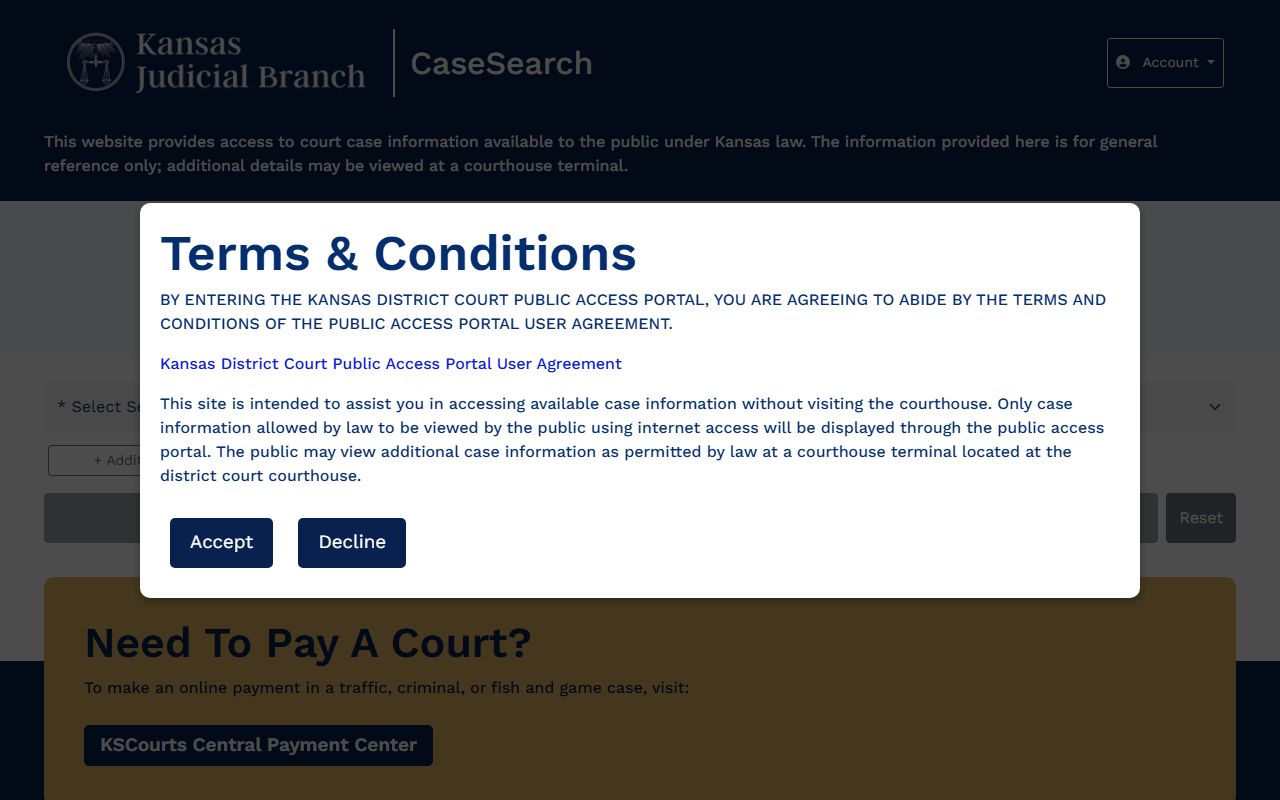
The portal image helps distinguish the court lookup channel from the sheriff's jail roster channel.
Sumner County Arrest Charging Documents
After a Sumner County jail arrest, the court record is built from charging documents and later docket activity. The first document may not match the exact roster wording. A booking line is a custody record. A complaint, information, or indictment is the court accusation that can be tested, amended, dismissed, or resolved. Complaint and information are the terms most readers will see in many Kansas criminal cases, while indictment refers to a grand-jury charge.
| Document | Who Uses It | What It Does | Why It Matters |
|---|---|---|---|
| Complaint | Often filed by or through the prosecutor | States the alleged offense and starts or supports the criminal case. | It may be the first formal court record after an arrest. |
| Information | Filed by the prosecutor | Sets out formal charges without a grand jury indictment. | It may replace or refine the charge shown at booking. |
| Indictment | Returned by a grand jury | Accuses a person of an offense after grand-jury action. | It is less common in routine state cases but remains a charging path. |
The Sumner County Attorney page lists Larry L. Marczynski II as county attorney and identifies deputy roles for juvenile, child in need of care, misdemeanor traffic, and mental commitment matters. It also links policy documents and diversion materials. That office is the local point of transition from arrest facts to filed charges, so a court records search after a jail arrest should account for prosecutor decisions, not just the wording used by the arresting agency.
Sumner County Charge Status Records
Charge status is one of the main reasons court records after a jail arrest differ from jail roster entries. A roster can show a statute number, a short charge phrase, a bond field, or a hold. The court record can then show that the prosecutor filed a different count, amended the wording, reduced a charge, dismissed one count while keeping another, accepted a plea, or placed the person in diversion if eligible.
| Status | What It Means | How to Read It |
|---|---|---|
| Pending | The case or charge has not reached final disposition. | Check later docket activity before treating the matter as resolved. |
| Amended | The prosecutor changed charge text, severity, or count details. | Compare the amended filing with the original roster charge. |
| Reduced | A lesser charge was substituted or accepted. | The final charge may be less serious than the booking line. |
| Dismissed | The court or prosecutor ended a charge without conviction on that count. | Other counts or related cases may still remain active. |
| Conviction | A plea or finding of guilt was accepted by the court. | Use the final judgment, not the booking entry, for disposition. |
| Diversion | A prosecutor-supervised agreement may avoid conviction if completed. | Sumner County Attorney materials include diversion policy references. |
People often search court records after an arrest to learn whether a person was convicted. A charge is not a conviction. A pending charge is an accusation in the court file. A conviction requires a plea, verdict, or other guilt finding accepted by the court. Diversion is also different from conviction because it depends on a prosecutor-supervised agreement and completion terms.
Bond After Sumner County Arrest
Bond information can appear in both jail and court contexts. Sumner's detention page says the jail information line can provide bond amounts and basic release information. It also says detention staff cannot recommend a bail bondsman. Cash-only bonds are accepted for the full amount, and the sheriff warns that cash posted may later be subject to court costs and fines at the court's discretion.
| Bond or Hold | How It Works in Sumner County Records |
|---|---|
| Cash-only bond | The full amount is paid directly, with later court-cost or fine issues possible. |
| Surety bond | A private bail bond company may post bond, but jail staff do not recommend companies. |
| Personal recognizance | A court release based on a promise to appear, when allowed by the court. |
| No-bond hold | Payment alone will not release the person until court or agency action clears the hold. |
| Federal or USMS hold | Roster entries marked U.S. Marshals housing may depend on federal court or marshal action. |
| KDOC hold | A parole or probation hold can keep custody in place even when a local bond exists. |
Before posting bond, confirm custody, current bond, and any hold with the jail. If a court case has opened, check the district court record for later bond changes. A jail roster bond field can be useful, but it may not be the final answer if a judge, another jurisdiction, a federal agency, or KDOC has imposed a separate release limit.
Sumner County Warrants and Arrest
The Sumner County Sheriff's Office warrant page is a free public warrant search. It has a name field and paginated warrant entries. The sample fields include name, image area, warrant number, charges, bond field, date, age, sex, and race. Examples in the research included failure to appear, probation violation wording, traffic matters, misdemeanor entries, felony-related text, and contempt.
If a person is arrested on a Sumner County warrant, the jail roster becomes the custody lookup after booking and the district court record gives the case setting or charge context. Some municipal bench warrants may live in municipal court systems and may not appear on the sheriff warrant page. When the warrant page, jail roster, and court search disagree, verify with the issuing court or the sheriff's office rather than assuming one public screen is complete.
The official warrant result layout is shown on the sheriff's Sumner County warrant search.
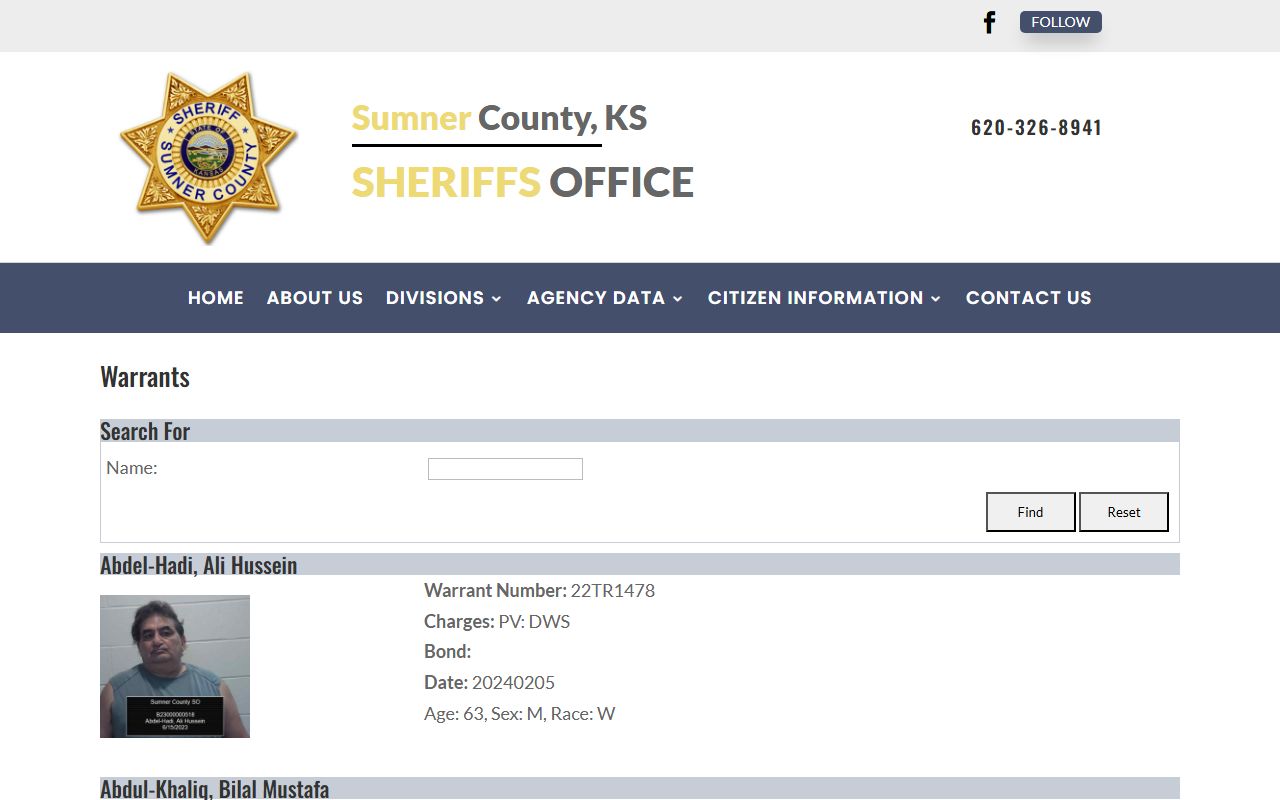
The warrant image is useful because warrant fields can lead to both a later booking record and a later court record.
Charges, Convictions, Sealed Records
Two comparisons prevent most mistakes in court records after a Sumner County jail arrest. First, a charge is not a conviction. Second, a sealed or expunged record is not the same as an ordinary public record. Kansas public access law starts with the Kansas Open Records Act, but exemptions, court orders, juvenile rules, sealed records, and expungement statutes can restrict what the public sees.
| Question | Charge | Conviction |
|---|---|---|
| Stage | An accusation filed or listed in a case. | A final guilt result through plea or finding. |
| Proof | Lower early-case standards may apply. | Guilt must be admitted or proved as required by law. |
| Record Use | Needs status review before being treated as resolved. | Use judgment and disposition entries for final outcome. |
Kansas expungement paths include K.S.A. 21-6614 for certain convictions, arrest records, and diversions, and K.S.A. 22-2410 for arrest records. Eligibility depends on the record and the case result. The research did not locate a Sumner County promise that a roster or court reference disappears automatically after dismissal or acquittal.
| Record Limit | Plain Meaning | Public Search Effect |
|---|---|---|
| Sealed | A court limits public access to the record. | Public portals may hide or limit the case or document. |
| Expunged | Kansas law gives a route to clear eligible arrests, diversions, or convictions. | Public access can be restricted if the court grants relief. |
| Closed by exemption | KORA allows some records to be withheld. | Juvenile, sealed, active investigation, or security concerns may limit release. |
Use limit: Public record lookups are not FCRA consumer reports and should not be used for credit, employment, housing, insurance, or similar screening decisions.
Sumner County Court Access Limits
The Kansas Open Records Act begins at K.S.A. 45-215, and K.S.A. 45-221 lists categories that may be closed. Sumner County's KORA overview says public agencies must act as soon as possible and not more than three business days after receiving a request, either by providing records, explaining when they will be provided, or saying why they cannot be provided.
The Kansas Attorney General KORA FAQ says jail rosters and police blotters are open to the public, but that does not make every court document or law-enforcement record public in full. Juvenile records, sealed court records, expunged records, active investigative materials, and some security-sensitive records can be limited. For case documents, use Kansas court request channels. For county records not posted online, use Sumner County's KORA process.
The county attorney office context appears on the official Sumner County Attorney page.
That source ties the court charge record to the prosecutor who decides what is filed after booking.